Best Kayak Carts: Five Options for Different Hulls, Loads and Launches
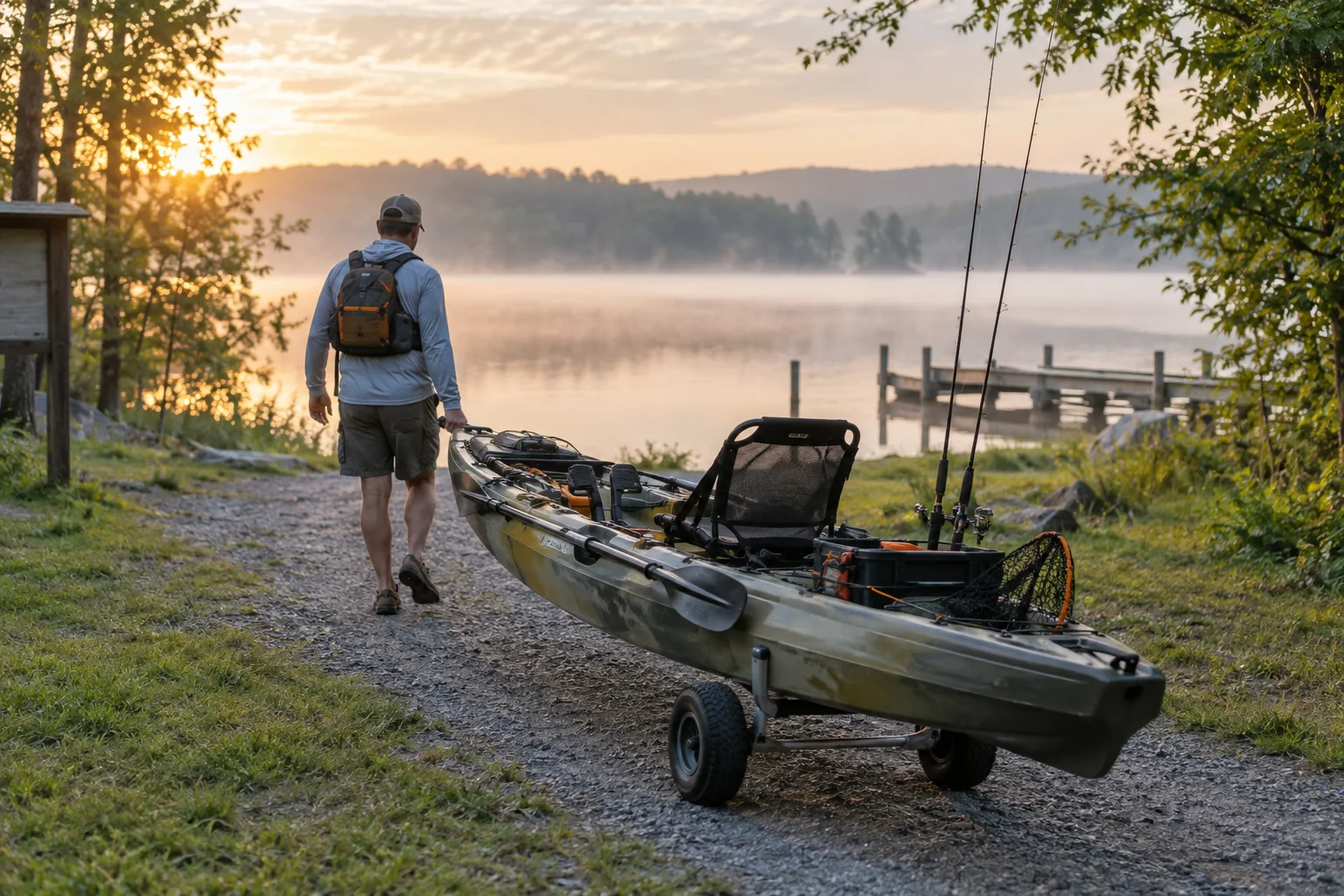
Getting your kayak to the water shouldn’t be the hardest part of the trip. But the cart that works for a short walk down a paved ramp may be a poor match for a sandy beach or a fishing kayak loaded with gear.
The trick is finding a cart that suits both your boat and the places you launch. The five carts below offer different ways to handle a heavy rig, support an awkward hull, or fit the cart aboard once you’re on the water.
Here’s where to start and what to check before buying.
Find a cart for your setup
- Heavy fishing rig: start with the Wilderness Systems Heavy Duty, provided its supports fit your hull.
- Need a different support arrangement: compare the Suspenz Catch-All.
- Lighter V-hull and limited storage: look at the Malone Nomad TRX.
- Considering a cart through the drain holes: check the boat-specific requirements for the Malone Xpress TRX.
- Want a cart that comes apart: the C-Tug R with SandTrakz is another option to investigate, with important hull and load restrictions.
Compare the carts
| Cart and configuration | When to consider it | Manufacturer-listed capacity | Listed cart weight | Main limitation |
|---|---|---|---|---|
| Wilderness Systems Heavy Duty, no-flat wheels, SKU 8070121 | Heavy fishing rigs with compatible hull support | 450 lb transport load | 15.12 lb | Check hull fit; this is not the beach-wheel version |
| Suspenz Catch-All Airless, SKU 22-9909 | Adjustable support for different hull shapes | 300 lb | 12 lb | Its airless configuration is not the soft-sand wheel option |
| Malone Nomad TRX, MPG523 | Lighter V-hull kayaks and onboard storage | 150 lb | 5.2 lb | Hatch fit and hull shape both matter |
| Malone Xpress TRX, MPG564 | A kayak whose manufacturer allows a scupper cart and whose scupper holes fit this model | 150 lb | Not listed | Hole spacing alone does not establish compatibility |
| C-Tug R with SandTrakz, 50-0014-71 | Compatible hulls where a dismantling cart is useful | 80 kg, about 176 lb, static | 10 lb | Static capacity is not directly comparable to a transport rating |
A wheel or frame change can change the rating, so check the version you’re buying against the one listed here.
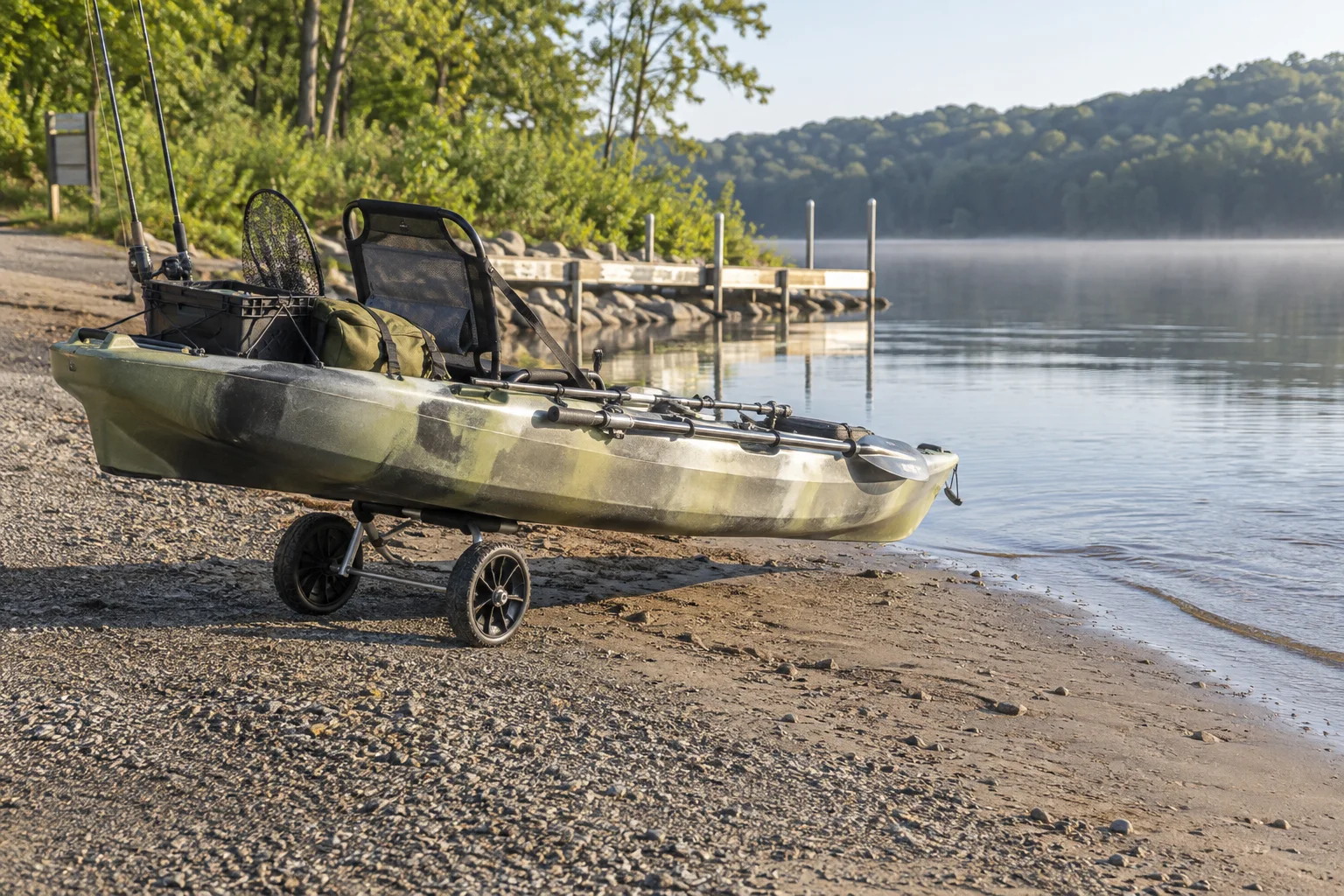
Wilderness Systems Heavy Duty: a starting point for heavy fishing rigs
Why consider it: A high listed transport capacity with adjustable hull support.
Main tradeoff: At 15.12 lb, the cart itself adds weight if you take it aboard.
The no-flat version has adjustable bunk width, two support heights and 12-inch airless wheels. You can adjust the spacing between the support bars to suit your hull. Wilderness Systems lists a 450-lb transport capacity and describes it as a cart for fishing kayaks and gear. Manufacturer specifications.
The appeal is the combination of load rating and adjustable support. If your rig is heavy, this is a good place to start. Before buying, check that its supports fit your hull. The high rating does not establish that the supports will contact your particular hull correctly.
The tradeoff is carrying the cart itself. At a listed 15.12 lb, it is substantially heavier than the Nomad. That may be acceptable if you return it to your vehicle; it deserves more thought if you must bring it aboard.
Choose it for a compatible heavy rig. Consider the Suspenz if its support arrangement fits your boat better, or the Nomad if your kayak and transported load suit a smaller cart.
The Wilderness Heavy Duty cart review takes a closer look at its adjustable supports, wheel options and onboard storage.
Suspenz Catch-All Airless: an alternative for adjustable hull support
Why consider it: Supports that can change orientation to suit different hull shapes.
Main tradeoff: The airless setup is different from the soft-sand wheel option.
The Catch-All uses bunk supports that can change orientation. Suspenz lists a 300-lb capacity, 12-inch airless wheels and a disassembled size of 33 × 11 × 6 inches. The frame can also accept a separate beach-wheel setup. Suspenz specifications and configuration details.
The adjustable supports are the main reason to consider the Catch-All. Compare the support arrangement with the underside of your kayak before deciding between it and the Wilderness cart.
Keep the wheel options straight. Suspenz describes the airless tires for surfaces including pavement, trails, packed sand and rocky terrain; it points to beach wheels for soft sand. Do not assume the base airless cart will perform like the beach configuration.
This is also a transport cart, not a storage stand. Suspenz warns that leaving a kayak stored on it can damage the airless wheels.
Malone Nomad TRX: a compact option for compatible V-hulls
Why consider it: A lighter, folding option for a compatible traditional V-hull.
Main tradeoff: Its 150-lb rating and hull requirements may rule it out for your fishing rig.
The Nomad’s strongest case is portability: a listed 5.2-lb weight, folding frame and folded dimensions of 26 × 14 × 4 inches. Malone rates it for 150 lb and says it works best with traditional V-shaped hulls. Nomad TRX specifications.
That makes it worth considering when your kayak fits that description and you want to take the cart with you. It does not make it an automatic choice for a wide, complex fishing-kayak hull.
Measure the hatch opening as well as the space behind it. A large interior compartment is no help if the cart’s components cannot pass through the opening. Check which parts must be removed to achieve the storage arrangement you intend to use.
Choose the Nomad when hull fit, load and storage measurements all work. For a heavier boat or different support geometry, return to the adjustable-bunk options.
Malone Xpress TRX: only for a compatible scupper setup
Why consider it: A scupper design for boats with documented permission and fit.
Main tradeoff: Matching hole spacing alone is not enough to establish compatibility.
The Xpress uses uprights that fit into scupper holes, the drain holes in a sit-on-top kayak. Malone lists a 150-lb capacity, adjustment for scupper centers from 3.25 to 16 inches, and uprights measuring 1 inch across with their foam padding. Its tires are 10-inch airless wheels. Xpress TRX specifications.
Treat those dimensions as checks, not a blanket promise of fit. Establish whether your kayak manufacturer permits this type of cart, then check the actual hole geometry and loaded weight. A vendor’s broad compatibility description is not a substitute for boat-specific guidance.
The Xpress is worth considering when that fit is documented. If it is unclear, investigate an external-support cart instead of forcing the uprights into place.
The model here is MPG564, rated at 150 lb. Do not substitute specifications from another Malone cart with a similar name.
C-Tug R with SandTrakz: check the exact hull and load basis
Why consider it: A dismantling design with adjustable rails, if your hull is supported.
Main tradeoff: The listed static capacity needs different interpretation from a transport rating.
This version combines adjustable rails with SandTrakz wheels and can be dismantled for storage. The international manufacturer page lists a 10-lb cart weight and 80 kg of static loading. C-Tug R SandTrakz specifications.
Compatibility matters particularly here. RAILBLAZA’s fit guide lists several Hobie models but excludes Native Slayer and Old Town Sportsman PDL 106/120 hulls. Check your exact boat rather than relying on the claim that adjustable rails accommodate different shapes. RAILBLAZA fit guide.
Consider it if the documented fit and dismantling design suit your needs. If loose beach sand is your main obstacle, compare it with suitable balloon-wheel options before choosing. The 80-kg figure describes a stationary load; it does not tell you the same thing as the Wilderness cart’s transport rating.
Be precise when shopping. The C-Tug R and the original C-Tug are different configurations; this entry is specifically the R with SandTrakz.
How to choose between them
Start with your route, hull, transported weight and storage plan. Our guide to choosing a kayak cart explains those checks in more detail.
Start with the route to the water
Consider the entire route to the water: pavement, gravel, a ramp, packed sand, or loose beach sand. Then compare the manufacturer’s terrain guidance for the exact wheel configuration you are considering. If soft sand is the deciding problem, resolve that requirement before choosing by weight capacity alone.
If beach launches are your main concern, compare these kayak carts for sand and their wheel, load and fit tradeoffs.
Check where the cart supports your hull
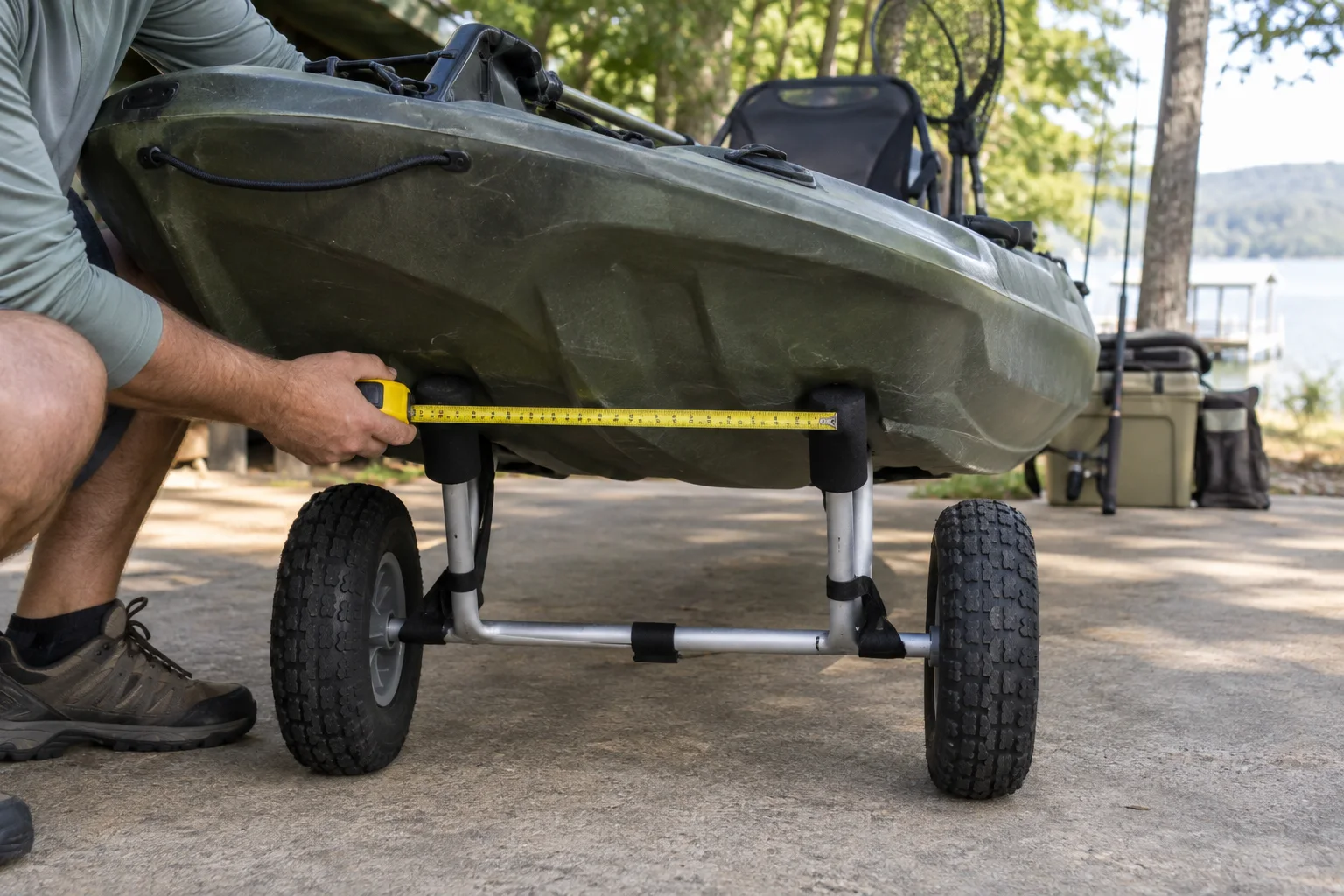
Identify the intended contact points and compare them with the cart’s adjustment range. For a scupper design, establish permission and fit for your boat. For external supports, check the hull shape and clearance. “Universal” is not a measurement.
Count the load you actually transport
Start with your kayak, then include the equipment left aboard during the move. Compare that load with the applicable manufacturer’s rating and instructions. A static-load rating describes a stationary load; check the manufacturer’s guidance for transporting your kayak over uneven ground.
Decide where the cart goes after launching
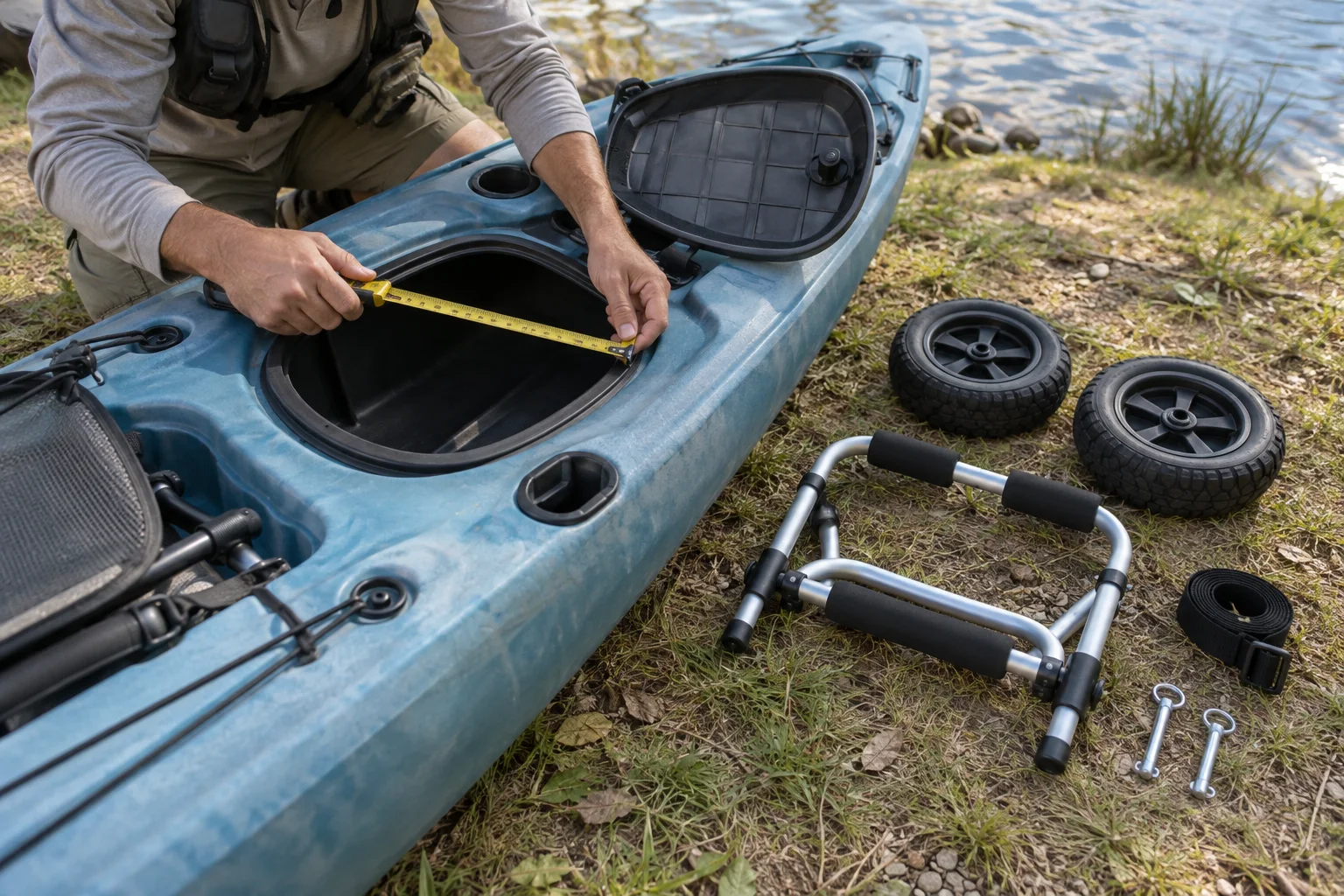
If it stays at the vehicle, packed size may matter less. If it goes aboard, measure the opening and available space, account for removable wheels and other pieces, and decide where those pieces will be secured. Choose around your actual storage arrangement.
Common questions
Will a cart rated for my kayak’s weight fit it?
Not necessarily. Capacity, hull contact and clearance are separate checks. Use the relevant fit guide or confirm the combination with the manufacturer.
Does “folding” mean a cart fits inside my hatch?
No. Compare the required opening and packed components with your kayak. Check both the entrance and the interior space.
Where should I position the cart?
Follow the cart and kayak manufacturers’ instructions for support location, securing the load and keeping parts clear. The right position depends on the hull and how the cart attaches.
Which kayak cart should you choose?
The right starting point depends on your boat, total load, and route to the water. For a heavy fishing rig, compare the Wilderness Systems Heavy Duty and Suspenz Catch-All. For a lighter V-hull where onboard storage matters, look at the Malone Nomad TRX. Consider the Malone Xpress TRX or C-Tug R only after confirming their specific fit requirements.
Before buying, check where the cart supports your hull, add up the weight you will actually transport, and choose wheels for the softest surface on your route. Those three checks matter more than any single capacity number.