How to Choose a Kayak Cart: Wheels, Mounting, Terrain and Weight Capacity
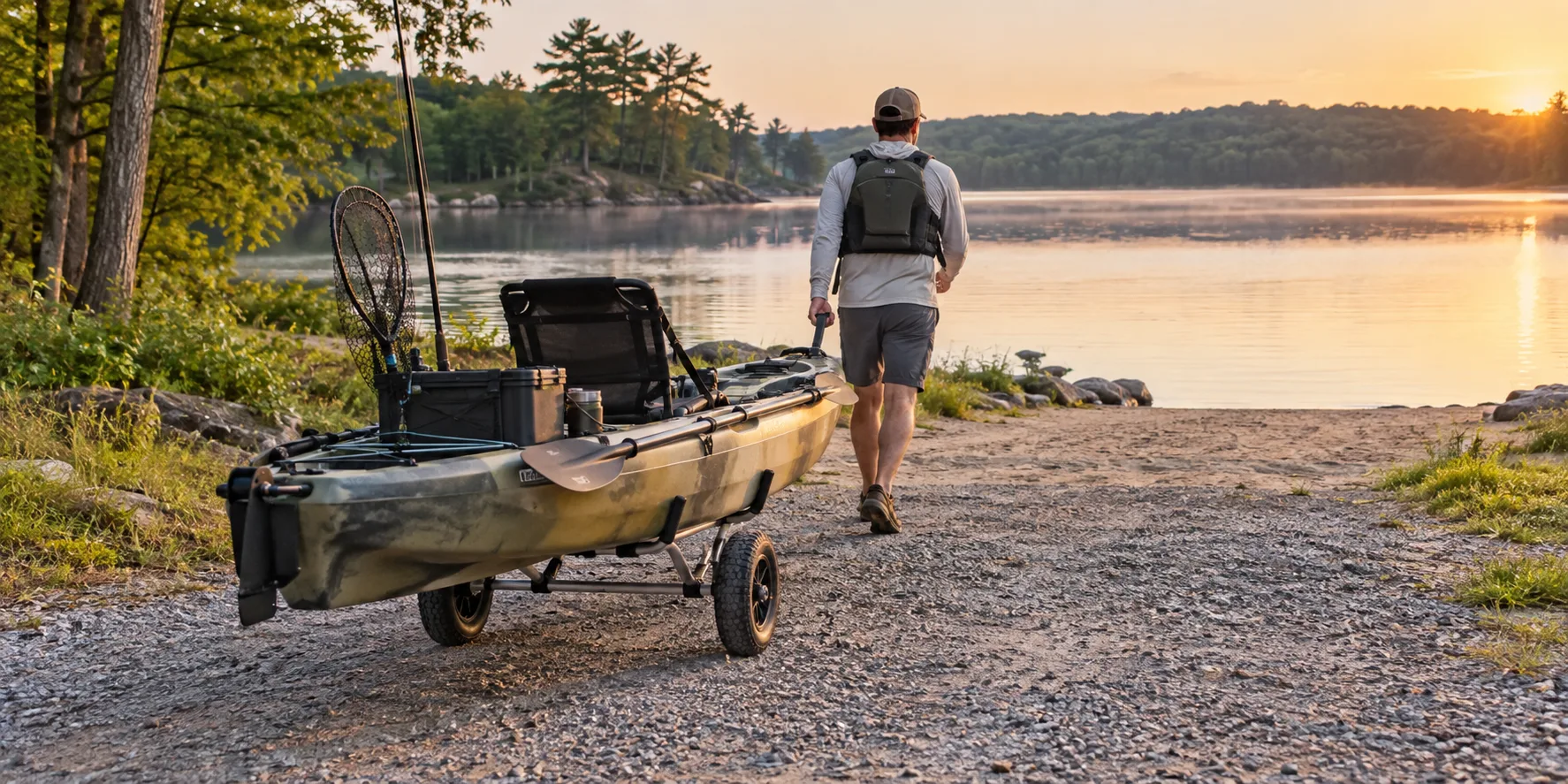
A kayak cart can look like a simple frame with two wheels until it meets the wrong stretch of sand, an awkward hull or a fishing kayak loaded for the day. That is usually when the small differences between carts start to matter.
The right choice depends on four things: the route to the water, the way the cart supports your hull, the weight you will actually move and where the cart goes after launch. Work through those in order and the options become much easier to compare.
Four checks before you compare carts
- Walk through the entire route. Include pavement, gravel, roots, ramps and the softest sand you expect to cross.
- Look at the bottom of your kayak. Identify safe support areas, channels, pontoons, scupper holes and anything that could interfere with a cart.
- Estimate the transported weight. Count the kayak and every item that will remain aboard while you pull it.
- Measure the storage space. Check the hatch opening and the usable space behind it, not only the cart’s advertised folded size.
These checks matter more than choosing the cart with the largest capacity number or the broadest “all terrain” label.
Start with the entire route to the water
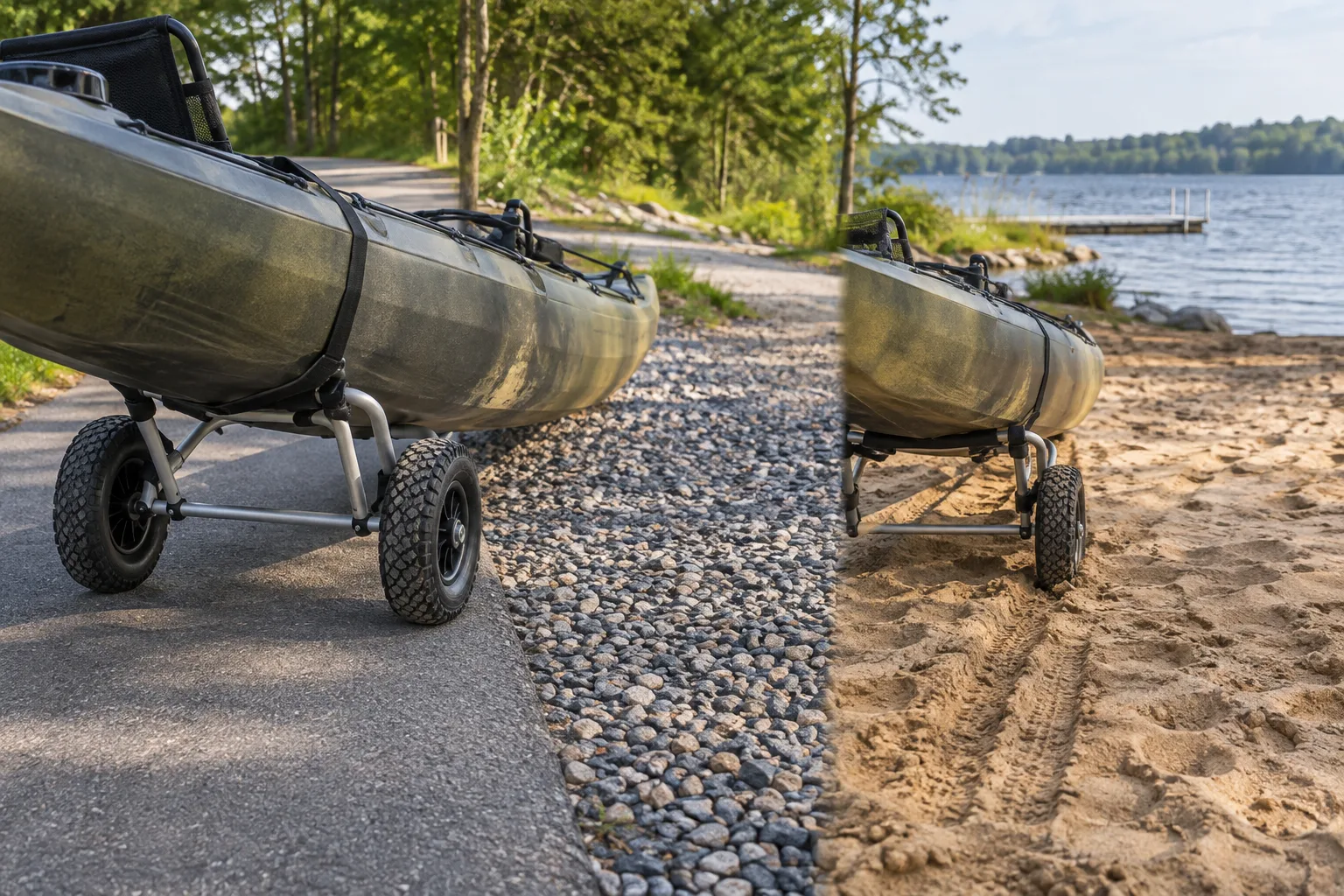
A short paved path and a loose beach ask very different things from a set of wheels. The route may also be mixed. A cart might roll easily across the parking lot, then dig in during the final fifty yards to the launch.
Airless wheels are a practical starting point for firm surfaces because they cannot go flat and some manufacturers specify them for pavement, trails, packed sand and rough ground. Wider beach or balloon-style wheels spread the load over more surface area and are the configuration manufacturers commonly direct toward soft sand and loose terrain. Suspenz, for example, lists its airless and beach-wheel options for different surface ranges rather than treating the two as interchangeable.
That does not make a beach wheel the automatic choice. Wider wheels add bulk and may change the cart’s capacity, packed size or clearance. If the route is mostly pavement and gravel with no loose sand, a compact airless setup may be easier to store and maintain. If soft sand is unavoidable, choose for that difficult section instead of the easy parking lot.
For specific beach-wheel and airless options, see the sand cart comparison.
Before buying, write down the surfaces in order and note the section most likely to stop a narrow wheel. That gives you a more useful requirement than “all terrain.”
Match the support to your hull
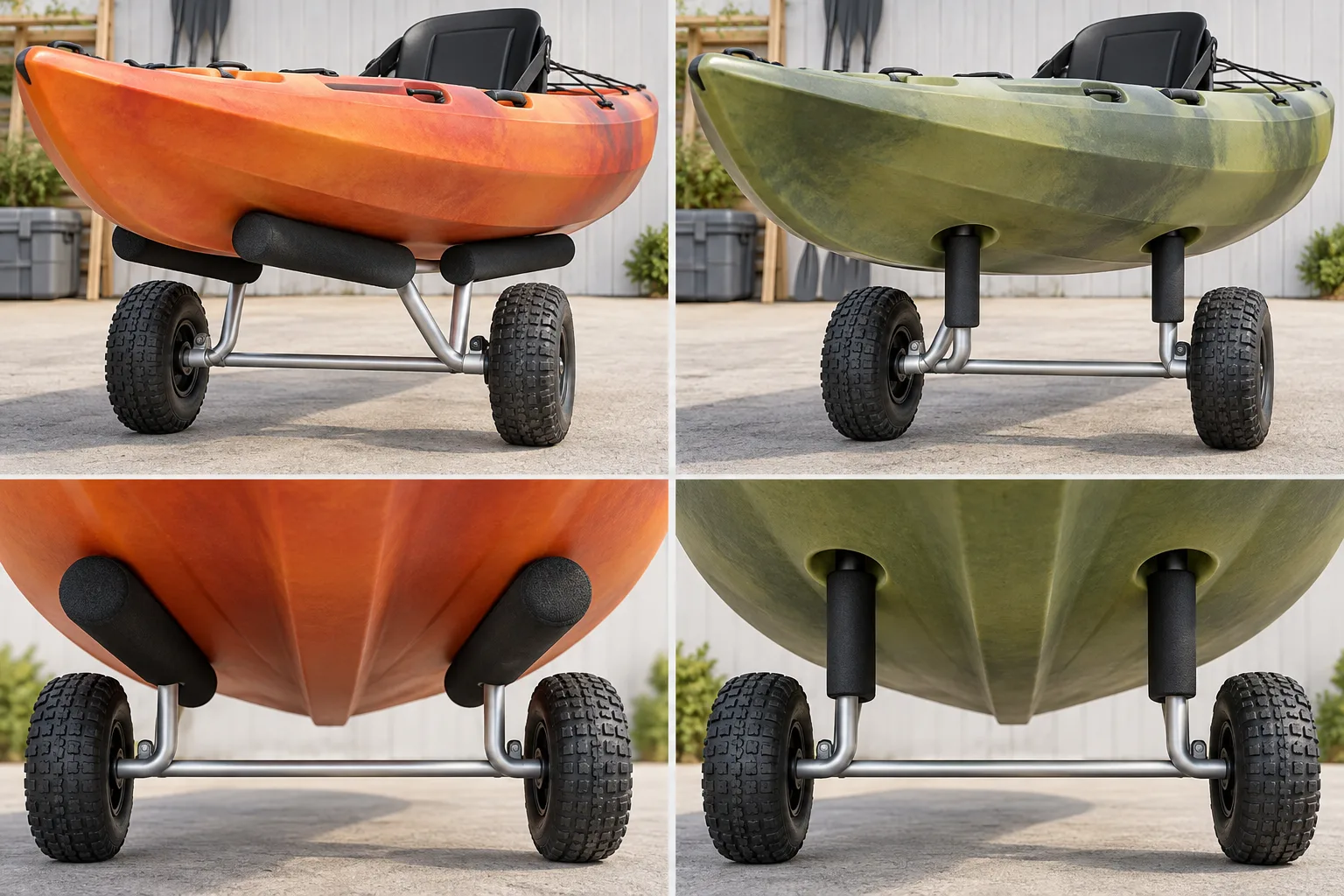
Most kayak carts fall into two broad mounting styles. Platform, bunk or rail carts support the outside of the hull and use straps to hold the boat in place. Scupper carts place upright posts through the drain holes of a compatible sit-on-top kayak.
External-support carts can work with many hulls, but adjustability is not the same as guaranteed fit. The support points need to sit securely against the hull without concentrating the load on an edge, interfering with a rudder or drive area, or allowing the kayak to twist. Wilderness Systems describes adjustable bunker width and two height positions on its Heavy-Duty Cart. RAILBLAZA similarly tells owners to position the C-Tug R rails to match the particular hull.
Complex hulls deserve extra attention. Channels, pontoons and deep keels can leave a seemingly adjustable cart resting in the wrong place. A model-specific fit guide is stronger evidence than a general “universal” claim. RAILBLAZA’s C-Tug R fit guide lists compatible models and also identifies hulls that do not fit.
Treat scupper compatibility as a boat-specific question
Post spacing is only the beginning of a scupper-cart check. You also need the post diameter, usable height or insertion depth, padding, the cart’s load rating and approval from the kayak manufacturer.
The Malone Xpress TRX, for example, publishes adjustable spacing and post diameters. Those measurements help determine whether the cart can physically enter a set of scupper holes. They do not establish that the kayak maker allows the hull to be carried that way.
Old Town makes the distinction clear in its kayak-cart guidance. It discourages scupper-style carts for its kayaks because of potential wear and hull damage, and recommends cradle or strap-style support instead. Check the instructions for your exact kayak before assuming that matching hole spacing is enough.
Calculate the weight you will actually move
Start with the kayak’s published weight, then add whatever stays aboard for the walk to the water. That may include the seat, pedal or motor system, battery, crate, rods, electronics, anchor gear and tackle. Water or mud left in the boat can add more weight on the return trip.
Compare that total with the rating for the exact cart and wheel configuration. Do not borrow a number from a similar model or assume a wheel upgrade leaves every other rating unchanged. Manufacturer figures vary widely. Current examples range from 150 lb for Malone’s Nomad and Xpress TRX carts to 300 lb for the Suspenz Catch-All Airless and 450 lb for the Wilderness Systems Heavy-Duty cart.
The label behind the number matters too. A static loading figure is not automatically the same as a transport rating over uneven ground. If a manufacturer does not explain the basis of a rating, treat it cautiously rather than converting it into a stronger claim.
Capacity is still only one filter. A high-rated cart can be a poor choice if its supports miss the stable areas of your hull, its wheels do not suit the launch or the assembled cart is too large to bring aboard.
Check placement, balance and securement
There is no single axle position that works for every kayak and every cart. Moving the cart toward the stern can make loading easier but leave more weight in your hands. Moving it closer to the balance point can reduce the lifting load but may interfere with the hull shape, rigging or drive system.
Use the cart maker’s instructions as the starting point. RAILBLAZA advises owners to find the position that suits the hull, while its C-Tug R instructions call for matching the rails to the kayak. Malone’s Nomad instructions require the wheels, hardware and straps to be checked before transport and note that severe terrain may call for another strap.
Whichever design you choose, confirm that the boat cannot slide or rotate when you lift the carrying end and change direction. Follow the exact strapping path in the cart instructions. Extra webbing cannot correct support points that do not fit the hull.
Decide where the cart goes after launch
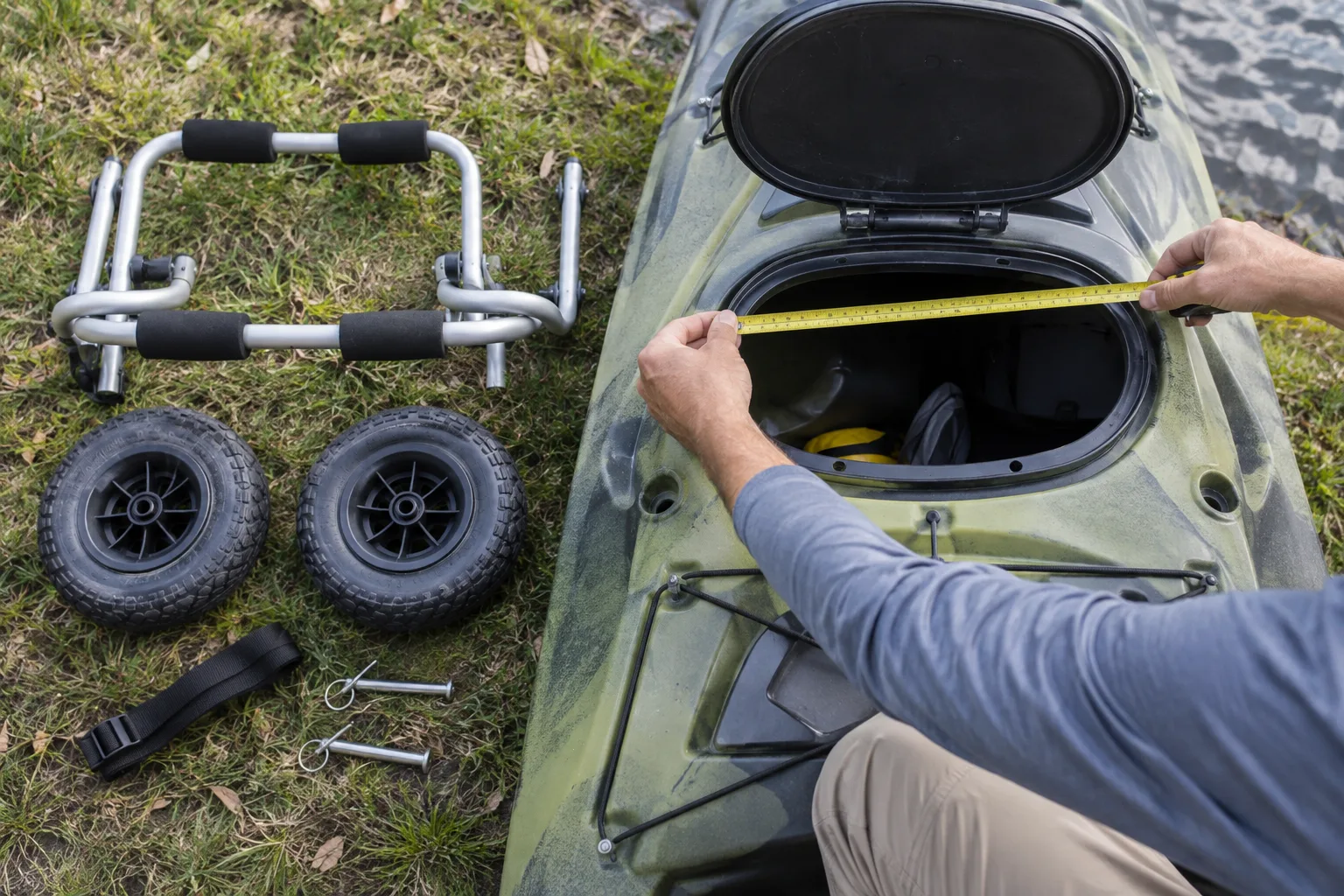
“Folding” and “fits in a hatch” can hide several different storage arrangements. Some carts fold as one frame. Others break into rails, wheels, pins and straps. The longest part may matter more than the overall volume.
Measure the narrowest part of the hatch opening, then check the turns and obstructions immediately behind it. Compare those measurements with every packed component. The Malone Nomad TRX, for example, lists a folded size of 26 × 14 × 4 inches. Suspenz lists its disassembled Catch-All at 33 × 11 × 6 inches. Neither set of dimensions proves that the cart will pass through your particular hatch.
Also decide how you will contain loose parts. A cart that technically fits but leaves wet or sandy wheels rolling around the tankwell may be less convenient than a slightly heavier frame that straps securely on deck.
If the cart stays at the launch or in a vehicle, packed size may matter less. In that case, prioritize the route and hull fit before paying for a compact design you do not need.
Common kayak-cart buying mistakes
| Mistake | Better check |
|---|---|
| Choosing from capacity alone | Confirm hull support, terrain and storage after the load rating passes. |
| Treating every beach as the same | Separate firm access roads and packed sand from loose, deep sand. |
| Assuming adjustable means universal | Compare the support points and clearances with the actual hull. |
| Matching only the scupper spacing | Confirm kayak-maker approval, post diameter, height and load. |
| Trusting “folding” without measuring | Measure the hatch opening, interior path and longest loose part. |
| Copying another owner’s cart position | Start with the instructions and balance the cart on your own hull. |
A simple measurement sheet
Record these details before comparing models:
- Route: firm surfaces, rough obstacles, packed sand and loose sand.
- Kayak: exact model and year, hull shape, safe support areas and maker restrictions.
- Transported load: kayak plus the equipment that remains aboard.
- Mounting measurements: bunk or rail contact area, relevant clearances, and scupper dimensions only when the kayak maker allows that style.
- Storage: hatch opening, interior clearance, available deck space and the longest packed cart component.
With those numbers in hand, you can compare the current kayak cart options against requirements that come from your own boat and launch.
Common questions
Are balloon wheels always better for a kayak cart?
No. Their wider footprint is useful on soft sand and loose ground, but they take up more space and can change capacity or clearance. Airless wheels are often the simpler choice for pavement, trails, gravel and packed surfaces. Choose for the most demanding part of your normal route.
Is a higher weight capacity automatically safer?
No. The rating must cover the transported load, but the cart also needs suitable hull contact, stable securement and wheels that fit the terrain. Check whether the published number is a transport rating and whether it applies to the exact wheel configuration.
Can any sit-on-top kayak use a scupper cart?
No. Scupper-hole spacing does not establish approval or structural compatibility. Check the kayak manufacturer’s guidance for the exact model, then compare post spacing, diameter, height and the cart’s load rating.
Where should a kayak cart sit under the boat?
The useful position depends on the hull, cart design and how much weight you can comfortably lift at the other end. Follow the cart instructions, keep the supports on suitable areas of the hull and verify that the strapped kayak stays stable when turning or crossing uneven ground.
What to check before choosing your cart
Start with the route, then rule out carts that do not suit the hull or mounting method. Confirm that the exact configuration can carry the loaded kayak, and measure the packed parts if the cart must come aboard.
The next practical step is simple: write down those four requirements before looking at another product page. A cart that meets all four is a better starting point than one that wins on capacity, wheel size or folded dimensions alone.